Custom laminated glass : A durable glazing solution

What is laminated glass ?

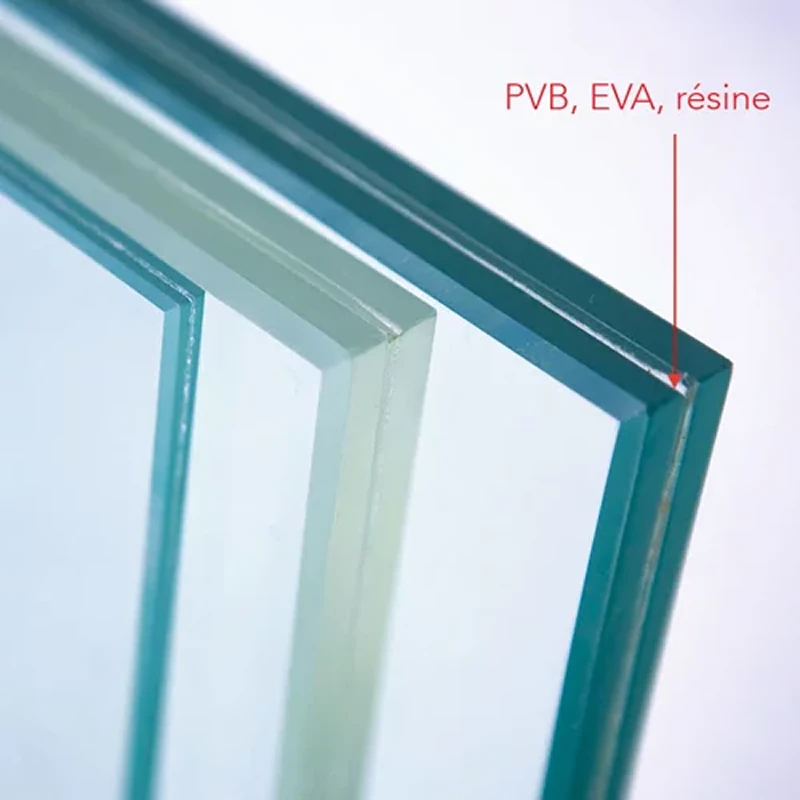
Laminated glass is a multifunctional glazing solution, often used for its exceptional safety properties. Composed of several layers of glass and plastic films, it plays a key role in protecting against glass breakage and the risk of injury. If the glazing breaks, the plastic films (PVB or Evasafe) hold the glass fragments in place, thereby reducing potential hazards.

VIT STOP CHOC custom-made laminated glass consists of layers of glass and PVB or Evasafe films, forming a solid, impact-resistant unit that remains in place even after breakage. This product is particularly suitable for applications requiring enhanced safety, especially in high-risk areas.
Feuilleté - Mobile

The advantages of custom laminated glass

Enhanced Security
In the event of breakage, the plastic films hold the glass in place, preventing injury.
Burglary protection
VIT STOP CHOC laminated glass provides a deterrent against vandalism and break-ins.
Customised aesthetics
Available in a variety of finishes (opal, decorative, burglar-proof), these glazing options can be adapted to suit all architectural styles.
Sustainability
Thanks to the accumulation of layers of glass and film, laminated glass is thicker and stronger than standard float glass.

Technical characteristics of custom laminated glass

VIT STOP CHOC laminated glass consists of several layers of glass (clear float glass, coloured glass, etc.) and plastic films. The standard thickness of PVB films is 0.38 mm, and that of Evasafe films is 0.40 mm. The glass is therefore thicker and more resistant than standard glass, offering enhanced safety performance.

Definition of laminated glass compositions

The designation of laminated glazing follows a simple rule: XXY or XX.Y or XX/Y, where :
XX, where each X corresponds to the thickness of a float glass component (in mm).
Y represents the number of plastic films integrated into the glazing.
Example: A laminated glass composed of a 4 mm glass and a 6 mm glass with two plastic interlayers is designated as 46², 46.2 or 46/2.

Classification of laminated glass

The EN 12600 standard defines the safety levels and the behavior of glazing in case of breakage based on a pendulum test (double tire test simulating the fall of a 50 kg mass on samples measuring 1938 mm x 876 mm).
This classification is expressed according to:
The level of impact to which the sample has been subjected :

• 1 for a drop height of 1200 mm
• 2 for 450 mm
• 3 for 190 mm

The type of breakage. It is expressed from A to C (annealed glass A), (laminated glass B), (tempered glass C).
The maximum level of stress that the product has significantly withstood (without allowing a 76 mm sphere to pass through and without significant glass fragments being projected). This level is expressed on a scale of 0 to 3.
1B1 glazing is therefore laminated glass whose sample has been subjected to a drop of
1200 mm and has withstood level 1 stress.
The EN 356 standard classifies glazing according to its resistance to attacks, thrown objects or attempted break-ins.
Vandal-resistant glazing, classes P1A to P5A (4.1 kg ball dropped from a height of 1.50 m to 9 m).
Burglar-resistant glazing, classes P6B to P8B (hammer and axe attacks).
Please feel free to take a look at the STOP CHOC PLUS range, our burglar-resistant glazing.
The EN 356 standard defines the ability of glazing to withstand projectiles.
Base composition in annealed glass according to NF EN 572-2

Reference: NF EN ISO 12543-2 (nominal thickness in mm)
33.2 44.2 55.2 66.2
6.8 8.8 10.8 12.8
Maximum surface in square meters (m²)
Glass considered as guardrails without prior testing (according to DTU 39)
0.50 2.00 4.50 6.00
– Rebate (pf) on the entire perimeter with sealing gaskets;
– Minimum rebate depth (pf) = 15 mm;
– The profiles forming the rebate must meet the requirements of paragraph 8.3 of NF DTU 39 P1-1 :
The profiles forming the rebate must have sufficient rigidity, ensuring a deformation less than or equal to 1/300 of their length under 800 Pa, applied on the infill element;
– For glazed walls, the top rail, when located within the protection height, must be validated under an M50/900J impact test, in accordance with P 08-302.
Custom laminated glass applications
STOP CHOC laminated glass is ideal for various applications where safety is paramount, such as :
Guardrail : Prevents falls by providing maximum safety.

Shop windows and facades : Provides security against break-ins while allowing maximum visibility.

Roof glazing : Resistant to impacts and extreme weather conditions.
STOP CHOC PLUS burglar-resistant glazing : Enhanced security for sensitive buildings.

Precaution when installing insulated glass balustrades.

The installation recommendations in DTU 39 must be followed :
Impact-side glazing Opposite-side glazing
Annealed Heat-strengthened Tempered HST 1C1 Tempered HST 1C3, 1C2 Tempered HST NPD Laminated PVB 1B1 or Other 1B1 and P1A Other laminated
Annealed NO NO YESa) b) NO NO YES NO
Heat-strengthened NO NO YESa) b) NO NO YES NO
Tempered 1C1 YESa) b) c) YESa) b) c) YESa) d) e) YESa) d) e) YESa) b) c) YES YESa) b)
Tempered 1C3, 1C2 or NPD NO NO YESa) b) NO NO YES NO
Laminated PVB 1B1 or Other 1B1 and P1A YESc) YESc) YESe) YESe) YESc) YES YES
Other laminated NO NO YESa) b) NO NO YES NO

a) With residual protection according to NF P 01-012:1988.

b) Justification of non-breakage of the 1C1 component.

c) Justification of non-breakage of the opposite-side glazing.

d) Justification of non-breakage of either component.

e) Justification of non-breakage of the opposite component if it is thicker than 10 mm.

Applications

Partition

Discover

Windows
& doors

Discover

Showcase and
glass roof

Discover

Veranda

Discover

Custom laminated glass :
the ideal solution for your projects

Custom laminated glass is an ideal glazing solution to combine safety, aesthetics, and technical performance. Whether you need impact-resistant glass, burglar-resistant solutions, or options for guardrails and display cases, STOP CHOC glazing provides a solution tailored to each requirement.

FAQ – Everything you need to know about custom laminated glass

What is STOP CHOC laminated glass ?

STOP CHOC laminated glass is a type of glazing consisting of several layers of glass and
plastic film, designed to offer increased safety in the event of glass breakage. It keeps fragments in place and protects against the risk of injury or break-ins.

What are the advantages of laminated glass ?

Laminated glass offers protection against injury, increased impact resistance and plays an important role in preventing break-ins. It is also available in a variety of finishes, allowing it to be adapted to different aesthetic requirements.

How does laminated glass work in the event of breakage ?

In the event of breakage, the plastic films that hold the different layers of glass together keep the glazing intact, preventing dangerous glass fragments from scattering. This reduces the risk of injury and property damage.

What types of films are used in laminated glass ?

The most commonly used interlayers are PVB (Polyvinyl Butyral) and Evasafe, both of which provide high impact resistance while keeping the glass shards in place.

How is the safety of laminated glass certified ?

STOP CHOC laminated glass undergoes safety testing, including drop and burglar-resistance tests. Classifications include standards such as NF EN 12600 and NF EN 356, which ensure impact resistance and protection against object penetration.

Downloadable documents